醫學院114-2學期雙語計畫【醫學系傑出系友系列講座】講座: 3/11(三)情緒的神經科學The Neuroscience of Human Emotions
114-2學期中國醫藥大學醫學院雙語計畫【醫學系傑出系友系列講座】
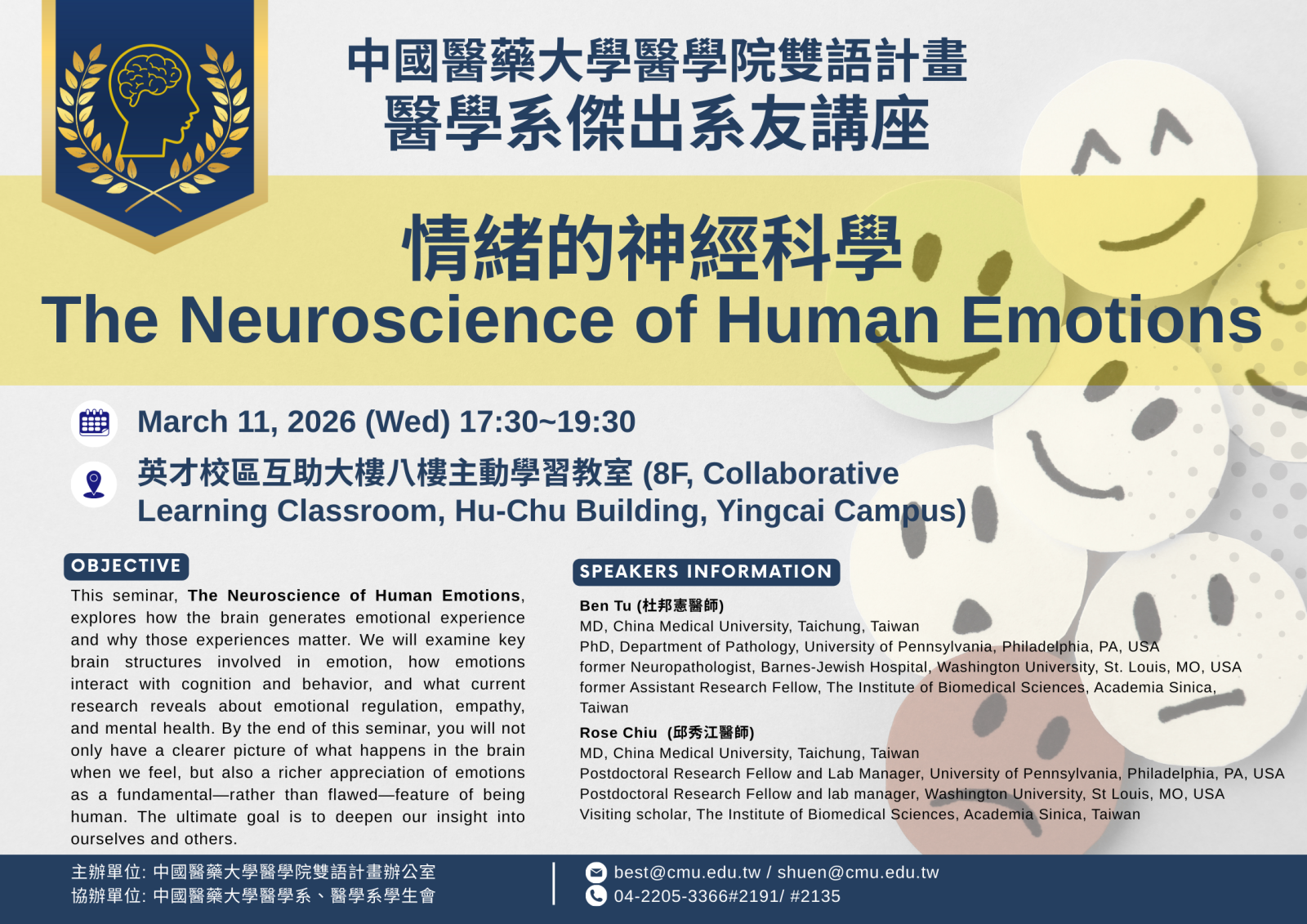
講座主題 Title: 情緒的神經科學The Neuroscience of Human Emotions
Date: 2026年03月11日 (三) 17:30~19:30
Venue: 英才校區互助大樓八樓主動學習教室 (8F, Collaborative Learning Classroom, Hu-Chu Building, Yingcai Campus)
講座語言: 雙語 (英文和中文)
Online Application: https://forms.gle/uaS1a8xv2D6PNr4W6
Application Deadline: 2026年03月06日(五)中午12:00前
**當天全程參加學生可獲得參加證明 (電子檔),並認列「通識教育活動時數-
**前30名報名學生可獲餐點乙份。
講座簡介 Lecture Introduction:
當喜悅、恐懼或悲傷的一瞬間來臨時,你是否任由它們劫持你的思考?你是否將情緒視為「不理性」的存在,並努力想把它們推到一旁?簡而言之,你比較像一位斯多葛學派的人,還是伊比鳩魯學派的人?
在人類歷史的大部分時間裡,情緒常被視為站在理性的對立面,一旦失控便極其危險。然而,當代神經科學卻講述了一個截然不同的故事。情緒深深嵌入於大腦的結構之中——從杏仁核的快速放電,到前額葉皮質整合與調節的功能,我們的情緒生活是由複雜的神經網絡所塑造,這些網絡幫助我們生存、適應環境,並與他人建立連結。情緒絕非可有可無,它們在我們的選擇、人際關係,以及自我認同中,都扮演著關鍵而決定性的角色。
本次講座《人類情緒的神經科學》將探討大腦如何產生情緒經驗,以及這些經驗為何如此重要。我們將介紹與情緒相關的關鍵腦部結構,說明情緒如何與認知與行為相互作用,並分享當前研究對情緒調節、同理心與心理健康的最新洞見。透過這場講座,你不僅能更清楚地理解「感覺」發生時大腦內部的運作,也能更深刻地體會情緒乃是人之為人的基本特質,而非需要被修正的缺陷。最終的目標,是加深我們對自己與他人的理解。
Do you allow a moment of joy, fear, or grief to hijack your thinking? Do you dismiss emotions as “irrational” and struggle to push them aside? In short, are you more of a Stoic—or an Epicurean?
For much of human history, emotions were treated as the opposite of reason and as something dangerous once they slipped out of control. Today, neuroscience tells a very different story. Emotions are deeply embedded in the brain's architecture. From the rapid firing of the amygdala to the integrative work of the prefrontal cortex, our emotional lives are shaped by complex neural networks that help us survive, adapt, and relate to one another. Far from being incidental, emotions play a decisive role in our choices, relationships, and sense of self.
This seminar, The Neuroscience of Human Emotions, explores how the brain generates emotional experience and why those experiences matter. We will examine key brain structures involved in emotion, how emotions interact with cognition and behavior, and what current research reveals about emotional regulation, empathy, and mental health. By the end of this seminar, you will not only have a clearer picture of what happens in the brain when we feel, but also a richer appreciation of emotions as a fundamental—rather than flawed—feature of being human. The ultimate goal is to deepen our insight into ourselves and others.
Speakers information:
Dr. Ben Tu (杜邦憲醫師)
- MD, China Medical University, Taichung, Taiwan
- PhD, Department of Pathology, University of Pennsylvania, Philadelphia, PA, USA
- Former Neuropathologist, Barnes-Jewish Hospital, Washington University, St. Louis, MO, USA
- Former Assistant Research Fellow, The Institute of Biomedical Sciences, Academia Sinica, Taiwan
Dr. Rose Chiu (邱秀江醫師)
- MD, China Medical University, Taichung, Taiwan
- Postdoctoral Research Fellow and Lab Manager, University of Pennsylvania, Philadelphia, PA, USA
- Postdoctoral Research Fellow and lab manager, Washington University, St Louis, MO, USA
- Visiting scholar, The Institute of Biomedical Sciences, Academia Sinica, Taiwan
Dr. Tu's previous research spans a range of neurodegenerative diseases, including Alzheimer's disease, Parkinson’s disease, amyotrophic lateral sclerosis (ALS), and Huntington's disease, aiming to elucidate the pathogenic mechanisms underlying these conditions. Some of his works have contributed to the ongoing efforts to develop new treatments. He has also published and co-authored multiple papers on brain tumor research.
Dr. Chiu's previous research involved creating mouse models for heart diseases related to abnormalities in lipid metabolism, which have become important tools for understanding the pathogenesis of these diseases and for developing new treatments.
主辦單位: 醫學院雙語計畫辦公室 | 協辦單位: 醫學系、醫學系系學會
TEL: 04-22053366 ext.2191/ ext. 2135
EMAIL: shuen@cmu.edu.tw (Ms. Chen)/ lihsin@cmu.edu.tw (Ms. Lee)